
Artists/Bands [B]
Backlash to Blue Max ……. p.1
Bogislav to to Butch, Liz and Duncan ……. p.2
NB: If an individual’s Christian or surname is currently unknown this is indicated by an asterisk placed between brackets [*].
BOGISLAV
(ca. 1970-71)
- Personnel: Rob Barwick (vocals) ▪ Ron Carpenter (drums/vocals) ▪ Tim Crozier (vocals) ▪ Dave Frogatt (guitar/vocals) ▪ Chris Hales (organ/vocals) ▪ Dave Highet (flute/bass/vocals) ▪ Andy Richardson (lead vocals/guitar) ▪ Don Walker (keyboards/vocals) ▪ Laurie Wheaton (bass)
Formed in Armidale sometime around 1970-1971, the original Bogislav line-up comprised University of New England (UNE) students Ron Carpenter and Dave Frogget, along with Laurie Wheaton, Chris Hales and Rob Barwick. About a year later the band was joined by Dave Highet, who initially provided flute and vocals, before moving to bass after Laurie Wheaton left. Ron Barwick was later replaced temporarily by Andy Richardson. In addition to playing at UNE (including college balls), Bogislav secured regular gigs in Armidale and nearby towns. The band also travelled to Tamworth on a number of occasions. Although heavily influenced by heavy rock and blues acts like Cream, Led Zeppelin, Traffic, John Mayall’s Bluesbreakers and Deep Purple , the band also played classic songs from the era by bands like the Rolling Stones (“Gimmie Shelter”), Chicago and Santana (“Soul Sacrifice”). Brian ‘Lanky’ Moore recalls the band jamming on “Gimmie Shelter” with seminal hard rock band Blackfeather during one memorable Armidale gig. The band also performed numerous original songs.
Sometime in 1972 Chris Hales left the band and was replaced by another UNE student, Don Walker (later of Cold Chisel fame). That same year the Bogislav entered the national Hoadley’s Battle of the Sounds, but didn’t play the Armidale heats (believing that another local band, Mantra, was more likely to win). A decision was made to play the Grafton and Tamworth events so as to increase its chances. This paid off because although the band got beaten in Tamworth by Just in Time, Bogislav won the Grafton heats. Around the same time, Andy Richardson left the band and was replaced by Tim Crozier (formerly from the Newcastle band Luke’s Harp). Crozier, who was then living in Sydney, had previously been asked to join the band after Ron Barwick’s departure but that fell initially through. With only a few days notice before the Northern New South Wales zone final (held in Newcastle), Crozier learned the songs from a tape and had one rehearsal with the band – the day before the event. Despite competing against a strong line-up, notably Newcastle bands Armageddon and Mata Hari, Bogislav went on to win. It then competed in the State Finals (held in Sydney) which was won by pop band Sherbet (which later went on to win the National competition). The 1972 competition also happened to be the last sponsored by the Hoadley company.
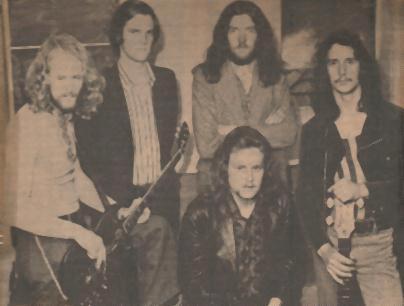 Bogislav, ca. 1972. L-R: Dave Frogatt, Don Walker, Ron Carpenter, Tim Crozier (seated), Dave Highet.

Following its success in the Battle of the Sounds competition Bogislav returned to Armidale where it put its high reputation to good use by securing regular gigs throughout Northern New South Wales. The band is believed to have broken up in late 1972 when several members completed their studies and moved away from the area. Most of the group went on to join other bands either in Armidale or elsewhere, with Don Walker becoming the most well-known after co-founding Cold Chisel in Adelaide the following year. Ron Carpenter also played in an early AC/DC line-up before joining former Bogislav members Dave Froggat abd Dave Highet to form Aleph, one of the region’s most popular touring bands of the mid to late-1970s, as well as elsewhere.
Bogislav: “Friends, Beggars, Louts and Thieves.” Live at the 1972 Hoadley Battle of the Sounds Zone Final (Newcastle, NSW).
Bogislav: “All Along the Watchtower.” Live at the 1972 Hoadley Battle of the Sounds Zone Final (Newcastle, NSW).
- See also Tim Crozier’s “Bogislav” entry in the Newcastle Bands Database (online) [sighted 7/05/2023]
- For further details on Hoadley’s National Battle of the Sounds see the NTMIA’s Industry: G-L page and the Milesago website [sighted 7/05/2023]
– Sources: Ron Carpenter (buoy.com interview – online, 2006; see his entry for further details) • Tim Crozier. “Bogislav.” Newcastle Bands Database. • Chris Hales (correspondence, 2010 – thanks Brian Moore). Image: Courtesy of Tim Crozier “Bogislav” (Newcastle Bands Database – online).† Music: Courtesy of Brian Moore.
– “Friends, Beggars, Louts and Thieves” is an original Bogislav composition (the writers are yet to be identified). “All Along the Watchtower” written by Bob Dylan.
REG BRAUN
(1941-)
- Bands incl. The Beardy Brothers [above] ▪ TRB4 (Townsville, Qld)
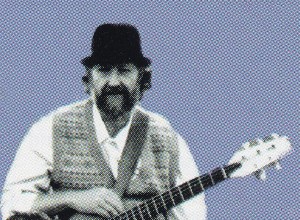
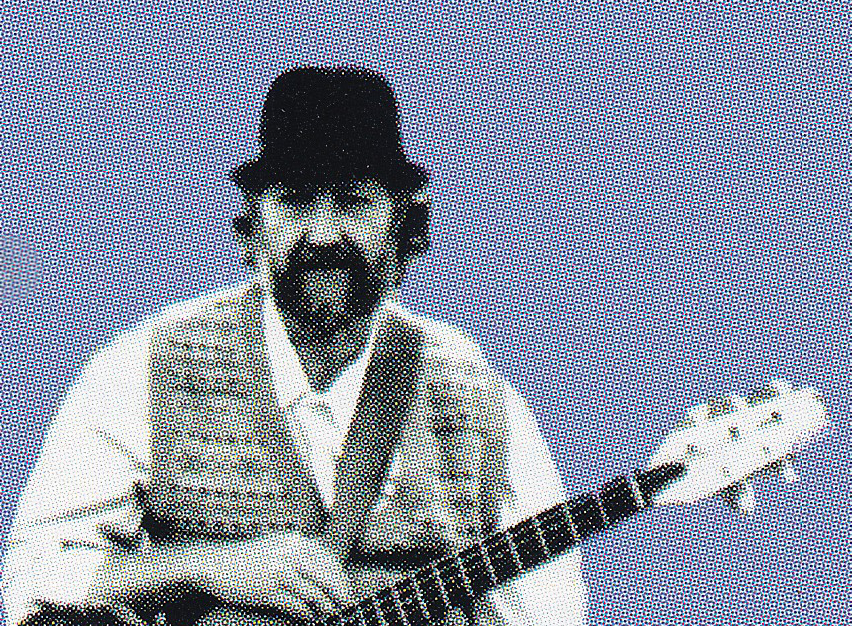
Bass guitar, drums, percussion, vocals, songwriter, producer, band leader, arranger, instrument repairer/restorer, teacher.
Perhaps best remembered in the Northern Tablelands, and particularly in Armidale, for his thirteen-year tenure with The Beardy Brothers, Reg Braun is a particularly gifted musician, capable of playing any genre both on bass and on drums. He also co-produced the band’s 1999 album, Been A Long Time, with Keith Cornish, while also contributing three songs, two of which feature him on lead vocals.
As a bass player Braun prefers the rare five string bass, and in this respect he had one hand built for him. Even more unusual is his tuning preference. While a four string bass is typically tuned to E-A-G-D, most five string bass players have the added advantage of a low-B (thus B-E-A-G-D). Braun had his set up with standard E-A-G-D but with the high-fifth string tuned unusually to C. As Keith Cornish recalls in 2024, this means that Braun’s string ‘patting’ can use the same fingering over any part of the neck. Also known as ‘slapping’ or ‘thumping,’ ‘patting’ is a technique that involves striking the bass strings with the thumb and then ‘pulling’ the string with the index or middle finger to create a percussive sound). Another feature of his bass playing is the difficult technique of “double pulling,” whereby the back of the fingernail and the front of the finger are used almost simultaneously. You can hear a great example of Braun’s bass style on his Beardy Brother’s song “Do Right.”
 In the early-2000s Braun left Armidale for Townsville where he quickly established a reputation as one of Far North Queensland’s more prominent and highly regarded musicians. In 2010 he formed The Reg Braun Four [left], better known simply as TBR4, and over the years has also appeared with other jazz ensembles, including the Hot Club Quartet and the Sugar Trio. Even in his eighties Braun continues to teach music (drums and bass) and offers his services for instrument repairs and settings.
The Beardy Brothers. “Do Right.” (1999) [words/music by Reg Braun] From the album Been a Long Time (The Beardy Brothers). Reg Braun: lead vocals/bass/drums.
The Beardy Brothers. “Time Sure Flew.” (1999) [words/music by Reg Braun] From the album Been a Long Time (The Beardy Brothers). Reg Braun: lead vocals/bass/darabuka/percussion.
- Discography [pdf]
Sources: “Beardy Bros Keith Cornish.” Interview. “Bluegrass Radio.” 2ARM FM 28 June 2024. Daryl Albertson (aka Herb), interviewer. [sighted “Armidale Livin’ – Music, Motors and Melodies of Life.” YouTube, 14 Dec. 2024] • “TRBF (The Reg Braun Four).” Townsville Jazz Club (“Bands” page) [last updated 15/12/2024; sighted 18/12/2024]. Images: Top: Been A Long Time CD (1999) • Bottom: Townsville Jazz Club.
RHONDA BURCHMORE
(1960 – )
- Bands: John Grigg Quartet
Born Sydney and raised in the suburb of Beverly Hills, Rhonda Burchmore spent much of her youth training as a singer, dancer and actor. At age 15 she left school to try her hand in the theatre but after a series of disappointing experiences returned to finish her schooling. In 1977 Burchmore moved to Armidale initially to undertake training as a primary teacher at the Armidale College of Advanced Education (A.C.A.E.). After graduating with a Diploma of Education she took up a scholarship to study Theatre Arts at the University of New England where she eventually graduated with a Bachelor of Arts degree. While living in Armidale between 1977 and 1979 Burchmore was heavily involved in both student and community theatre. Among the productions she has been identified with to date are The Death of Everyman (UNE Arts Theatre, April 1977) staged by the A.C.A.E. Drama Group; and Fiddler on the Roof (Armidale Town Hall, Sept. 1978), put on by the Armidale Drama and Musical Society.
An anecdote Burchmore tells from her time at Armidale concerns the almost complete removal of one of her toes while taking part in a university revue. “My girlfriend and I… were dancing in the bathroom, as you do, practising our steps to Cocaine. I hasten to add we were dancing to Cocaine the song, not dancing on cocaine. At one stage I whipped my leg around in some attempt at a fancy twirl and managed to put my foot through the ceramic basin of the bathroom sink which promptly smashed to pieces. And there was my little toe, just hanging there, all blood, bone and gristle. Lovely. I had to be rushed to hospital where for some reason the only doctor available was a neurosurgeon. Fortunately, he was as good with little toes as I hope he was with people’s brains and he stitched me up as good as new’ (Jacobson, n. pag.). Burchmore’s talent as a singer and performer did not escape the attention of the local music industry, and within a year or so of arriving in Armidale the 18 or 19 year old was invited by band leader/drummer John Grigg to front the John Grigg Quartet. In addition to Grigg and keyboard player Clive Gregory the ensemble also included Graham Wilson (guitar/vocals) who later went on to find fame as a member of the Four Kinsmen.
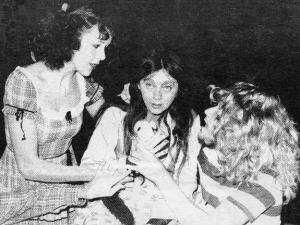
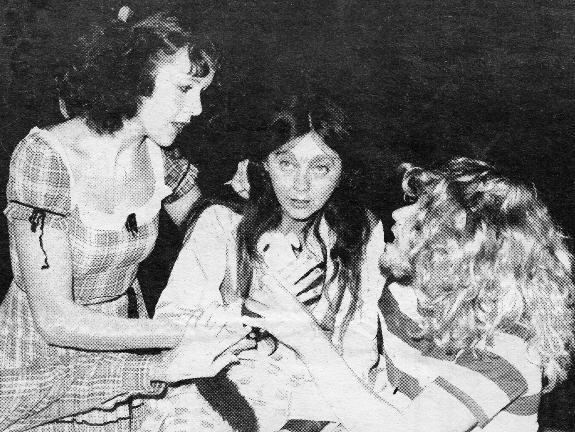
L-R: Rhonda Burchmore (Baby), Margaret Clay (Everymum), Peter Currie (Sonny) in The Death of Everyman (1977)
After leaving Armidale Burchmore made her international breakthrough in the 1982 film The Pirate Movie (playing the role of Kate). In 1987 she featured in David Atkins’ Dancing Man, and the following year garnered much critical acclaim six years later, playing opposite Garry McDonald and Broadway star Eddie Bracken in Sugar Babies (1988). That same year she reprised her role in London’s West End opposite Mickey Rooney and Ann Miller. A string of productions followed before David Atkins cast her in his musical extravaganza, Hot Shoe Shuffle (the role having been written especially for Burchmore). Following its successful debut in London in 1994 the musical toured Australia and received rave reviews from the critics and sold out audiences.
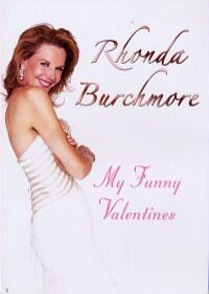
In 1997, Burchmore provided the opening performance at Melbourne’s Crown Casino with her own cabaret spectacular, Red Hot and Rhonda. The show went on to entertain 60,000 people. She followed it with a role on Broadway in the Irving Berlin classic Easter Parade, followed by another Broadway show Into the Woods (Stephen Sondheim). Burchmore returned to Australia in 1998 and released her self titled debut solo album. Since then she has released at least four further albums – Midnight Rendezvous, Live At The Melbourne Concert Hall, Pure Imagination and My Funny Valentine. Burchmore’s career has seen her appear on numerous Australian variety television shows, most notably Hey Hey It’s Saturday (in which she often appeared in the ‘Celebrity Head’ segment. In addition to her performances and celebrity appearances she has been accorded a number of prestigious awards, including Australian Club Entertainment (ACE) awards for Best Female Variety Performer and Variety Performer of the Year (1999), and Best Female Variety Performer (2000). Burchmore also received the 2000 Mo Award for the Best Female Variety Performer.
 Among her career highlights since the late 1990s have included playing the lead role in The Production Company’s first show, Mame (1999), and principal roles in such musicals as Guys and Dolls, Mamma Mia, Urinetown: The Musical, Tom Foolery, Respect: A Musical Journey of Women; the stage shows Song and Dance, They’re Playing Our Song, Lend Me a Tenor; and her own productions – Rhonda Burchmore Sings ‘n Swings, My Funny Valentines and Fever. Burchmore also received critical acclaim for her performances as Queen of the Fairies in the Victorian Opera company’s productions of Iolanthe, Die Fledermaus (as Prince Orlofsky), Ruddigore and An Evening with Sondheim. In 2008, Burchmore again received glowing reviews and standing ovations when she revived her role in Mame for The Production Company.
- For further details on Rhonda Burchmore’s career see her website: rhondaburchmore.com [sighted 7/05/2023]
Sources: Rhonda Burchmore official website • Suzanne Carboni, ‘Giant Steps are What She Takes,’ Age (Melbourne) 11 Aug. 2009 • Michael Jacobson, “A Dish Called Rhonda.” Goldcoast.com 21 Nov. 2009 • Peter Thompson (interviewer), “Rhonda Burchmore” Talking Heads, ABC TV 15 Sept. 2006 • “Rhonda Burchmore.” Wikipedia [sighted 7/05/2023] . Images: Production photo (The Death of Everyman) from the Armidale Express 20 Apr. (1977), p. 11 † (courtesy of Margaret Clay) • My Funny Valentine LP cover courtesy of the Kaleidoscope label † • Rhonda Burchmore LP cover courtesy of W.T.S. Entertainment. †
GRAEME BURTON
(1964 -2007)
-
Bands incl. ftprints11
Drums/bass/vocals
A longtime friend and collaborator with Richard Rummery, Graeme Burton was well-known in Armidale, having established himself in the local music industry for many years. In the early to mid-2000s he provided additional instruments for Rummery’s ftprints11 project. Burton passed away in late 2007 from complications brought on by diabetes.
Source: Richard Rummery (correspondence, 2009).
BUTCH, LIZ AND DUNCAN
(ca. 1974-76)
This harmony vocal trio is thought to have formed sometime around 1974 while the members were studying at the University of New England. In his review of the group’s performance as support to Mike McClellan at the UNE Arts Theatre in 1975 (22-23 Mar.), Terry McArthur records: ‘”Local group, Butch, Liz and Duncan (with Steven Kiely sitting in on piano) had in the preceding year built up a large following. This was due to their beautiful songs… Their trademark, as a group, was the wall of sound harmony” (p. 14).
The trio’s repertoire comprised a selection of original compositions along with traditional folk, popular, soul and gospel-style songs, including “Poor John,” “Rally for the Wounded” and “Leaving You.” The group also presented political satire as part of their act, with one ‘madcap’ sketch being “Spotlight.”
NB: Advertising for the McClellan concerts, as well as the 1975 Jesse Winchester performance (Madgwick Hall, 22 Sept.), indicate that the support act for both shows was called Organization. It is yet to be confirmed whether Butch, Liz and Duncan performed under that name (Terry McArthur does not mention Organization in his review).
Source: Terry McArthur. “Mike McClellan… Where Does He Go?” Neucleus (Armidale) 7 Apr. 1976, 14. [attached pdf]
have gravity will threaten
† Copyright for this image has either not been ascertained or we have been unable to locate the owner . If you are the copyright owner and want the image removed please contact this website. To see HGWT and the NTMIA’s copyright statement go to the “About the Northern Tablelands Music Industry Archive” page.

Northern Tablelands Music Industry Archive
Pages: 1 2
 Have Gravity Will Threaten