
Artists/Bands [C]
NB: If an individual’s Christian or surname is currently unknown this is indicated by an asterisk placed between brackets [*].
CAPTAINS OF INDUSTRY
(1983-1985)
- Personnel: Jane Hewetson (bass) ▪ Ziggy Mirza (guitar/vocals) ▪ Ian Mitchell (drums) ▪ Peter Mitchell (lead vocals/guitar) ▪ Tim Rollinson (guitar).
- Also associated with the band: Chris Green (vocals) ▪ Clay Djubal (vocals)
Formed in Sydney in late-1983 by Armidale brothers, Peter and Ian Mitchell, Captains of Industry was essentially a vehicle for Peter Mitchell’s songs. During the previous few years Mitchell had been focusing on his songwriting craft, writing and recording several solo albums on a Tascam 144 (4-track) Portastudio in collaboration with his brother. These were subsequently made available on cassette format. Prior to joining Captains of Industry Ian Mitchell had been Shoot the DJ‘s drummer and sound recording engineer. The first line-up comprised the Mitchell brothers, Tim Rollinson and Jane Hewetson. Guitarist, Ziggy Mirza, another ex-member of Shoot the DJ, also eventually joined the band, replacing Tim Rollinson (who later went on to form the jazz/hop hop fusion band Directions in Groove (aka D.I.G.).
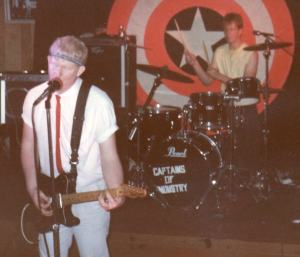 The Mitchell brothers ca. 1985

Captains of Industry received some initial interest from publisher Chappell Music, the charts were at that time dominated by New Romantic/synth pop and new wave ‘video’ rock bands. The Australian music industry of the early to mid-1980s was therefore not the time for word-centred bands like Captains of Industry. The band nevertheless established a small but enthusiastic following in Sydney, playing such venues as The Lismore Hotel (Pitt Street, Sydney), Vulcan Hotel (Ultimo), Trade Union Club, Harold Park Hotel, the performance Space (Redfern) and the infamous French’s (Oxford Street, Darlinghurst)
During the three years the band was together it recorded a good deal of material. Peter Mitchell indicates that at least 30 songs were recorded on the old Tascam 144. Six songs were produced in an 8-track studio at Alexander Mackie College (Paddington, Sydney). Another seven songs were recorded by Martin Cass at his JMC Studios in Elizabeth Street, Strawberry Hills (Sydney). Two songs from the JMC sessions were to be released as a single (“Skeleton Song” b/w “American Americans“), but according to Mitchell the band’s manager, “a somewhat shadowy publican with wharfie connections had paid for the recordings… with certain “illicit substances.” Owing to a subsequent supply problem he could not “pay” for the release of the record’ (p. 7). These two songs also feature guest backing vocals by former Armidale guitarist/singer Chris Green (Edge). Captains of Industry also recorded a version of their song “Setting the Pace” in 1983 with Clay Djubal singing co-lead vocals.
Captains of Industry. “Skeleton Song.” (1984) [words/music by Peter Mitchell]
Captains of Industry. “American Americans” (1984). [words/music by Peter Mitchell]
Captains of Industry. “Setting the Pace.” [1] (1983) [words/music by Peter Mitchell]
-
An alternative version of “Setting the Pace” with Clay Djubal as guest vocalist can be found in his bio.

- Discography [pdf]
– Source: Peter Mitchell, The Great Unknown (1995), 7, 12. Image: Photo courtesy of Peter Mitchell.(www.peterandpenny.com)
– See Wikipedia for entries on Tim Rollinson and Directions in Groove (D.I.G.). Rollinson also publishes his own website (Tim Rollinson) [sighted 6/06/2023]
– John Martin Cass is perhaps best known as the founder of the JMC Academy. [sighted 6/06/2023]
– “Skeleton Song” and “American Americans” are both included on Disk 1 of Mitchell’s 1995 The Great Unknown anthology.
RON CARPENTER
 Bands incl. AC/DC ▪ Aleph ▪ Bogislav ▪ Early Hours ▪ First Light ▪ The Generation ▪ Paddywack
- Also associated with Cold Chisel [below]
Born into a musical family, Ron Carpenter’s parents, grandparents and two sisters were all accomplished musicians. He took classical piano lessons for fifteen years, later taught himself guitar and played drums in his parents’ band. By age twelve he was writing songs and in 1965 formed the first of several high school rock bands – notably The Generation, Early Hours, and Paddywak (with Peter Sheedy).
While studying at The University of New England for four years, Carpenter co-founded Bogislav, arguably Armidale’s premiere hard rock band of the early 1970s. The band in fact made it all the way to the New South Wales State finals of the 1972 Hoadley National Battle of the Sounds competition. He also became interested in computers and synthesizers at this time, with that interest playing a major influence in shaping his later music career. Following the disbanding of Bogislav in late 1972 Carpenter moved to Sydney where over the period 1973-1974 he played in an early AC-DC line-up. Married at the time he was also teaching at a High School during the day, building a PA prototype in the afternoons and composing and playing at nights.

Bogislav (ca. 1972)
In 1974, while still with AC/DC, Carpenter co-founded the six-piece band Aleph with Dave Froggatt (guitar) and Dave Highet (bass/flute). All three had previously played together in Bogislav. The band’s repertoire comprised original compositions in the art/ symphonic rock genre, utilising such instruments as moog and Oberheim synths, Mellotrons, flute and elaborate guitar effects. The original Aleph line-up, which also included Mary Jane Carpenter, released one album, Surface Tension (1977).
By 1978 Aleph was in debt to the tune of $400,000, and this resulted in the band’s custom PA being repossessed, Carpenter took several months leave of absence to fill-in as drummer for Cold Chisel’s [see below]. His connection with the band was through Don Walker, who he’d previously played with in Bogislav. Carpenter also briefly formed the band First Light around this period. With that band he recorded and released a self-financed album in 1979.
 In 1979 Carpenter convinced the remaining members of Aleph (along with their families) to base themselves out of Byron Bay. Over the next few years the band whittled down from a five piece, to quartet and eventually to a trio, with Carpenter taking on lead vocal duties towards the end. The band managed to secure almost nightly gigs through until 1983 on the North Coast and Gold Coast, however, and according to Carpenter repaid most of the debt.
By the mid to late-1990s Carpenter’s interest in music technology led him to reject artificial surround sound formats such as Dolby, THX and DTS and he instead invented Plex technology, which allows him to position and control sound sources anywhere in a 3D speaker matrix. He argues that commercial surround sound systems are not much better than stereo because the music is mainly stereo recording masters which have been re-jigged to create an artificial surround sound experience. After securing sponsorship from Electro-voice (Australia) in 2003 he was able to demonstrate the system using sixteen SX300 speakers, two Dynacord 800 Sub-woofers, 2 kilometres of wiring and 60,000 watts of amplification. He has recorded hundreds of hours of music which allows him to utilise the system. By employing wireless in-ear monitoring Carpenter can spatialise a live band’s sound (as long as each musician plays an electric instrument so that no sound is produced on the performance stage). Carpenter believes that ultimate goal will be to involve composers and musicians in creating true 3D soundscapes at the start of the creative process (by exploiting the possibilities of space) rather than in the mastering stages of a recording [for more detailed insights into Plex see the Ron Carpenter biography below]
- “Ron Carpenter” [Buoy, 2006 article] [pdf] Reprint.
Source: Ron Carpenter (buoy.com article, 2006 – no longer available online) • “Aleph” (alexgitlin.com). Images: sourced from alexgitlin.com) †
ASHLEY CARROLL
-
Bands: Crash Landing [below]
Hailing from Katoomba in the New South Wales Blue Mountains, Ashley Carroll attended the University of New England in the early-1980s. While there he teamed up with Doiran James and Rod Clay to become Crash Landing‘s first and only “permanent” drummer. Carroll’s influence on the band could be heard in the group’s choice of several southern US boogie/hard rock songs from bands like Lynyrd Skynyrd and ZZ Top.
Source: Clay Djubal (2009). NB: Rod Clay: see Clay Djubal
THE CHOOKS
(ca. 1980-1982)
- Personnel: Kim Constable (bass/vocals) [below] ▪ Robert ‘Bob’ Jones (guitar/ lead vocals) ▪ Brian ‘Lanky’ Moore (drums/vocals) ▪ Mick O’Shea (drums) ▪ Davey Scotland (guitar/vocals)
After disbanding Constable, Green and Moore [below] in late-1980, Kim Constable and Brian Moore moved to Sydney where they teamed up with Bob Jones, Moore’s former band mate in Kelsey and Purple Haze. Jones had previously been playing in Sydney with a band called Stunned Mullett. Specialising in high energy rock/pop covers with a smattering of originals, the band built a strong following across Sydney playing venues such as the Oxford Tavern (Petersham), the Watson’s Bay Hotel, The Sussex Hotel and The White Horse. It was also firmly associated with The Sando (Sandringham Hotel, Newtown).
 Much of The Chooks’ appeal, apart from an extremely tight sound, lay in the ability of each of its members to work towards presenting a visually exciting show without relying on high production values. Among the band’s covers were songs by AC/DC, The Who, Joe Jackson, The Beatles, Herman’s Hermits, ZZ Top, The Animals, The Sex Pistols, The Small Faces, Nick Lowe, The Troggs, Bob Seeger and The Police. One particular favourite with audiences was the band’s cover of the AC/DC classic, “If You Want Blood (You Got It).” This rendition, invariably played at the end of the show, had them frothing fake blood from capsules. It was also not uncommon to See Bob Jones leaping up on any nearby platform – be it tables or the venue’s serving bar (notably The Sando) – spitting lyrics and blood over anyone not moving out of the way fast enough.
 The Chooks released at least one single, a cover of the Herman’s Hermits’ hit, “Something Good.” The B-side was a Bob Jones’ original, “Heads or Tails.” Before the band broke up sometime in late-1981 or early-1982, it was expanded briefly to a four-piece with the addition of guitarist/singer Davey Scotland. Mick O’Shea also briefly replaced Brian Moore near the end.
Bob Jones went on to form Forever 15 with Davey Scotland, while Kim Constable joined the Ratbags of Rhythm (as well as briefly appearing at the same time in the Conway brothers Carnival, a cabaret/vaudeville-style show). Lanky Moore returned to Armidale where among other things he helped manage Newell’s Music Centre, and later set up an Armidale branch of the Tamworth-based Cheapa Music store. Mick O’Shea later became a key member of The Choirboys, and was also associated with Dragon and the Divinyls at various times. By the mid to late-1990s Kim Constable and Davey Scotland were also playing together again in a revived Ol’55 line-up.
In 1986 all former members of The Chooks reunited at the Sandringham Hotel, with Brian Moore and Mick O’Shea sharing the drumming duties. The gig also featured a special guest appearance of Constable Green and Moore.
The Chooks. “Something Good.” (ca. 1981) Words/music by Bob Jones. Copyright Rockbottom.
The Chooks. “Heads or Tails.” (ca.1981)
- Discography [pdf]
- Repertoire [pdf]
– Source: Clay Djubal (2009) • Brian Moore (correspondence, 2010). Images: Flyer courtesy of Brian Moore.
– “Something Good” written by Gerry Goffin and Carole King (1964) as “I’m into Something Good.”
ROD CLAY
See: Clay Djubal
COLD CHISEL
(1973-1984; 1998 ; 2003)
 Cold Chisel, 1974. L-R: Ian Moss, Jimmy Barnes, Les Kaczmarek, Don Walker, Steve Prestwich.

- Personnel: Jimmy Barnes (vocals, 1973-) ▪ Les Kaczmarek (bass, 1974) ▪ Ian Moss (guitar/vocals, 1973-) ▪ Steve Prestwich (drums/vocals,1975-2011) ▪ Phil Small (bass/vocals, 1975-) ▪ Don Walker (keyboards/vocals, 1973-)
- Also associated with the band: Ron Carpenter (ca. 1978) [above]
Generally regarded as one of the leading Australian pub rock bands of the 1970s and 1980s, Cold Chisel formed as in Adelaide in 1973 (initially known as Orange). By the time the band officially disbanded for the first time (1984), it had released 6 studio albums and one live album. The band was inducted into the Aria Hall of fame in 1993, becoming the second of the 1970s bands to be accorded this honour (the first being Skyhooks). Cold Chisel’s classic line-up, beginning 1975, at which time it was largely based in Sydney, comprised Jimmy Barnes, Ian Moss, Don Walker, Phil Small, and Steve Prestwich. The band’s LP releases were : Cold Chisel (1978), Breakfast at Sweethearts (1979), East (1980), Swingshift (1981), Circus Animals (1982) Twentieth Century (1984) and Barking Spiders Live: 1983 (1984). The band also released the EP You’re Thirteen, You’re Beautiful, and You’re Mine in 1977. Among Cold Chisel’s canon of classic songs are : “Khe Sanh” (voted in a #8 in APRA’s all time greatest Australian songs poll), “Choir Girl,” “Cheap Wine,” “My Baby,” “You Got Nothing I Want,” “When the War is Over,” “Saturday Night” and “Flame Trees.”
The band’s connection with the New England region was due to principal songwriter and keyboardist, Don Walker. Although born in Ayr (North Queensland) he had grown up in Grafton in Northern New South Wales. he moved to Armidale in 1969 to undertake a science degree at the University of New England (UNE), and while there also played in the local hard rock outfit, Bogislav. One of the most popular bands in the Northern Tablelands at that time Bogislav’s claim to fame was making it to the New South Wales State finals of the 1972 Hoadley’s National Battle of the Sounds competition. In 1973, having completed his degree, Walker moved to Adelaide to work at the Weapon’s Research Establishment at Salisbury. The following year his newly-formed band, by then renamed Cold Chisel, temporarily relocated to Armidale so that he could complete his Masters degree.
While the length of the Cold Chisel’s stay in Armidale varies according to several sources (Jimmy Barnes claims it was for 12-18 months, for example), the ‘Gigs History’ page on the band’s official website indicates that it resided there for only 6-7 months (ca. March – September 1974). Nevertheless, in the Australian tradition of making anyone who stayed here for any length of time one of us (even New Zealanders), so Armidalian’s lay claim to playing a part in the Cold Chisel legend. Among the gigs they are known to have played were the Armidale Town Hall (2 Mar.), Therley Research station, Wool Shed (21 May, possibly a UNE college or Rural Science ball), and the old Armidale Teachers College (8 June). Cold Chisel even supported local band, Kesley, at one or more gigs, according to Rocky Lane (ctd. Harrison, 2013).
There were also some legendary parties. Clay Djubal recalls standing outside a house party in Donnelly Street, Armidale (near De La Salle College, now O’Conner High), where some band “from Adelaide” was in full swing. At 15 he was too intimidated to go inside, but hung around on the street because the music was very loud. Tony Jaggers notes, too, that another member of the band, Phil Small, also has an additional connection with the town. Small married Christine McKenzie, the daughter of local policeman Sergeant Murdo McKenzie, who was associated with the Police Citizens Boys Club for many years.
During it’s Armidale sojourn the band members lived on a property in the outlaying district of Kentucky. At that early stage the bass player was Les Kaczmarek. The Armidale connection was rekindled in 1978 when Don Walker’s former band mate in Bogislav, drummer Ron Carpenter, was asked to fill in for Steve Prestwich for several months.
Since officially breaking up in 1984 Cold Chisel have reformed briefly on several occasions, and have also released several albums of new material – notably The Last Wave of Summer (1998), No Plans (2012), The Perfect Crime (2015) and Blood Moon (2019) as well as several compilations/greatest hits packages.
Cold Chisel. “Wild Thing.” [live, 1978]
- To date there are no publicly-available Cold Chisel recordings (live or studio) made prior to 1978. The band’s cover version of “Wild Thing” was recorded live at the Regent Theatre, Sydney, in October 1978 and released on the band’s 1978 EP You’re Thirteen, You’re Beautiful, and You’re Mine.”
 The classic line-up. Source: Cold Chisel website.

- Visit the official Cold Chisel website at: Cold Chisel [sighted 14/06/2023]
– Source: Cold Chisel Official Site (online) • Tony Jaggers (correspondence, Nov. 2010) • Jo Harrison. “Music Mates Go Oldscool.” Star Community (Armidale) 11/07/ 2013 [sighted 12/06/2023].
– Images: Top photo source: New Idea (Sydney) 9 Dec. 2019, n.pag. † • Bottom photo courtesy of Cold Chisel website †
– Music: “Wild Thing.” written by Chip Taylor (1965).
KIM CONSTABLE
-
Bands: Carnival ▪ The Chooks [above] ▪ Constable, Green and Moore [below] ▪ Inner Soul ▪ Ol’ 55 ▪ On the Prowl ▪ Ratbags of Rhythm ▪ Robbie Gray Band ▪ Ukiah
Bass guitar/vocals.
An influential bass player/singer in Armidale during the late 1970s, Kim Constable played with Moree band Inner Soul before moving to Armidale in 1976 to join the Robbie Gray Band. After it disbanded he joined Ukiah before co-founding the hard rock outfit Constable, Green and Moore [below] in 1978. It was later known as Constable Green Moore and Brazil. In the early-1980s Constable moved to Sydney and soon afterwards joined fellow Armidalians’ Bob Jones and Lanky Moore in forming a three piece pop/rock band called The Chooks (1980-1981). Towards the end it became a four piece with the addition of Davey Scotland on guitar/vocals.
Between 1981 and 1984 Constable was a member of the Ratbags of Rhythm (1981-1984), a swing band which had some notoriety with its minor hit single, “I’ll Be a Baby for the Dingo on Your Heart.” The band also released an EP with the song on it. Towards the end of the band’s career Constable also became a member of the Mic and Tim Conway-led vaudeville/cabaret band, Carnival (1983) with fellow Ratbags of Rhythm drummer Warwick Kent.
Sometime around the mid-late 1990s Constable joined one of several “reformations” of the retro-1950s band Ol’ 55. The classic line-up (from 1975) had included Frankie J. Holden (vocals), Rockpile Jones (guitar/vocals) and Wilbur Wilde (sax/vocals). In 1999 this Rockpile Jones-led outfit included Kim Contsable, Davey Scotland, Mark Fairhurst and Peter Northcott. Constable and Rockpile Jones later played in another revived 1950s-influenced band, On the Prowl (ca. 2009). Kim Constable can be seen in the 2007 film Clubland (as one of the members of the wedding reception band).
Sources: “Old Beat Hard to Beat.” Post (Newcastle, NSW) 15 Sept. 1999, Te liftout. (available online TE Archive) • JacobsLearnEarn blog (no longer online) • Brian Moore (interview, Aug. 2010) • Ol’ 55 MySpace (no longer active) • ‘Captain Matchbox.’ Milesago.com (online – see ‘After Matchbox’ section)
CONSTABLE, GREEN AND MOORE
aka Constable, Green and Moore and Brazel
(1978-1980)

Kim Constable (bass/vocals) [above] ▪ Chris Green (guitar/vocals) ▪ Brian ‘Lanky’ Moore (drums/vocals) + Chris Brazel (keyboards/vocals)
Playing classic rock in the power-trio tradition of such iconic (three instrument) bands from the 1960s and 1970s – notably Cream, The Who, Led Zeppelin, Constable, Green and Moore (CGM) formed in early 1978. The older members of the group, Kim Constable and Lanky Moore, had already built solid reputations in the local industry, while Chris Green had attracted much attention during the previous two years as lead guitarist with the Duval High School band Edge, as well as a brief stint with Scamp, before it disbanded. Among the covers played by CGM were songs by Led Zeppelin, Grand Funk Railroad, Robin Trower, Free, Jimi Henrdrix, Neil Young and Supertramp. Australian covers were from bands such as Healing Force, Kevin Borich Express, The Angels and The Easybeats. Two factors which made GMC stand out from both previous and the current crop of local bands were its vocals and overall sound. With all three members being more than capable singers, the heavy rock style they generated though their instruments was often juxtposed by three-part harmonies. The Constable, Green and Moore sound was also due in part to its PA system, which was operated from the front-of-house. Before CGM few other local bands had had access to full sound production, and it was this fully professional feature that made the trio stand out immediately.
Constable, Green and Moore played its first gig at the Grand Hotel and quickly built a following playing all of Armidale’s major venues and in other Northern Tablelands towns. Surprisingly the band also scored frequent gigs at the Galloping Grape wine bar and bistro. Although more suited to small ensembles and lounge-style acts, the Grape’s management decided to try out Armidale’s loudest band and this proved to be a more than successful venture. The only problem in the end was that the band was so loud that it drew complaints from the Capitol Cinema, situated across the road in Beardy Street. Management tried to solve the situation with sound proofing and repositioning the band but in the end the venue proved to be unviable for full on rock bands.
 The highlight gig for Constable Green and Moore during its first year together was arguably the Rock Fest ’78 charity concert at UNE Great Hall (University of New England, 15 Sept.). Together with The Inmates and Patterson’s Curse, the trio supported the Melbourne ‘alternative/ pseudo-feminist’ band Stiletto (featuring singer/actress Jane Clifton). In addition to regular gigs at the leading Armidale venues like Impies (Imperial Hotel) and the UNE Union Bistro, Constable Green and Moore also began to score support gigs at the UNE Great Hall with high profile interstate bands like The Angels (25 May 1979) and Rose Tattoo (1 Nov. 1979), as well as the Armidale Town Hall (with Sherbet).
 Constable, Green, Moore and Brazel playing a Sunday afternoon gig at the Armidale Teacher’s College amphitheatre in 1980.

By late 1979/early 1980 the band became Constable, Green, Moore and Brazel, with the addition of keyboard player Chris Brazel. The band is believed to have called it quits sometime in 1980, with Constable and Moore moving to Sydney where they co-founded The Chooks [above] with former Kelsey frontman/guitarist Bob Jones. Chris Green also moved to Sydney, and shortly afterwards here he and fellow Armidale musician Dick Rummery joined the short-lived Shooting School. Green and Rummery also collaborated as recording duo – called Da Kaboodle. Constable, Green, Moore and Brazil have reformed several times for one-off gigs, including a fifteen year reunion in 1995 (see below).
Constable Green Moore & Brazel. “Livin’ Alone.” (1980) Recorded live.
Constable Green Moore & Brazel. “Lucille.” (1980) Recorded live.
Constable Green Moore & Brazel. “Ohio.” (1980) Recorded live.
Constable Green Moore & Brazel. “Don’t” [live] Original CGM&B composition.
Constable Green Moore & Brazel. “Flu.” (1980) Recorded live. Original CGM&B composition.
 A Constable Green Moore and Brazel reunion at the Club Hotel (ca. late 1980s)
- “Good ol’ Days are Here Again.“ [pdf reprint] Armidale Express 3 Jan. 1995, Gig Guide. [re: 1995 reunion]
- Repertoire [pdf] incl. 1995 reunion setlist
– Source: Brian Moore (telephone interview, Jan. 2010). Images: Band photos and Armidale Express article courtesy of Brian Moore† • Angels/Constable Green and Moore poster courtesy of Brian Moore†
– Music: All songs recorded live at Earl Page College, The University of New England, Armidale (NSW). “Livin’ Alone” (1973) written by John Bogert, Carmine Appice & Jeff Beck. “Lucille” (1957) written by Albert Collins and Richard Penniman (aka Little Richard). “Ohio” (1970) written by Neil Young and first performed by Crosby, Stills Nash & Young.
KEITH CORNISH
- Bands incl. The Beardy Brothers ▪ The Disconnections (Sydney) ▪ Firebirds
Originally hailing from Grafton, Keith Cornish was born into family with strong musical interests, including his grandparents. When his father gave him a ukulele at age nine he quickly learned to play it, and later taught himself to play guitar. In a 2024 interview broadcast on 2ARM FM, Cornish recalls having always sung, and that he played his first gig at South Grafton as a teenager, alongside his younger brother, Ian, and a friend. He further recalls that at the end of that night Australian country superstar, Slim Dusty, performed a couple of solo songs.
Cornish’s association with the Northern Tablelands began either in late-1959 or early-1960 when his family relocated to Armidale. He began his senior schooling at Armidale High in 1960 and four years later co-founded Firebirds with his brother and school mates Ralph Monley, Greg Goldsmith and Geoff Walsh. At the end of 1963 the Cornish family moved once again, this time to Casino, where Keith completed his final two years of schooling. In 1966 he moved to Sydney to begin studying for a diploma in marine engineering and construction at Ultimo College. These studies continued up until 1971. At some stage during the late-1960s Cornish found work as a musician playing in a band signed to Show Group Management. Known as The Disconnections, it initially worked the Miller’s pub circuit, playing professionally six nights a week with a repertoire comprising Beatles, Rolling Stones, Eagles and popular top 40 songs from the period. The band later graduated to playing premiere establishments like the Trocadero, and TAB balls. The band’s biggest crowd was as a support to Billy Thorpe during a beach concert with over 100,000 people.
In late-1971 or early-1972 Cornish left The Disconnections and Sydney to return to Armidale with his wife (his place in The Disconnections was taken by his brother Ian). In a 2024 interview with Bluegrass Radio host, Herb (aka Daryl Albertson) Cornish recalls that for the next 12 years he never picked up the guitar, his focus being his career and burgeoning family (eventually six children). By 1986 he was beginning to re-establish himself locally as a musician, and by chance was asked by Peter Stanley to fill in bass for one show at the Bowling Club as his regular bassist was unavailable. That opportunity led immediately to him being invited to join Stanley’s new outfit The Beardy Brothers, an association that lasted some 13 years. The band even released an album in the late-1990s called Been a Long Time. Several of Cornish’s songs feature.
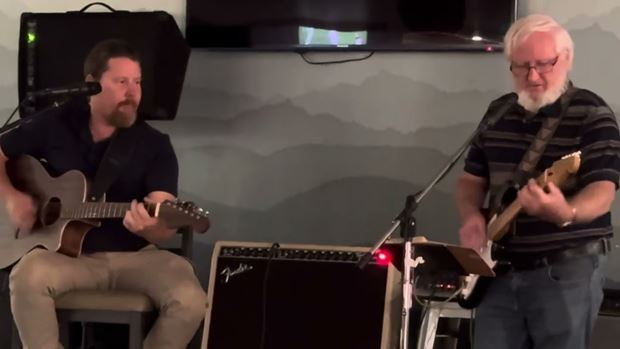
Since the disbanding of the Beardy Brothers, Keith Cornish has continued to combine his engineering career with music. Between 1988 and 2005 he was the Technical Services Manager at the University of New England, and held a similar position with the National Marine Science Centre (2003-05). From 2004 he has operated his own engineering design firm, while also serving as a consultant at MCS Group Holdings. As a musician he continues to appear regularly at various shows and events in the local area and further afield, often with his son Luke. In late-June 2024 Cornish, Pete Stanley and Gary Daly (along with ring-in bassist Mick Houlahan) performed a 30th anniversary Beardy Brothers reunion at Armidale’s Grand Hotel.
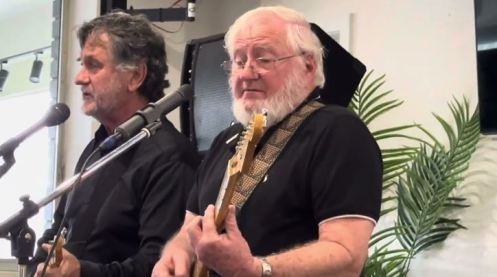 Pete Stanley (Left) and Keith Cornish (right) at The Beardy Brothers 30th Anniversary Reunion (Grand Hotel, Armidale, 30 June 2024)

The Beardy Brothers. “ Gina and Tina. (1998) [words/music by Keith Cornish] From the album Been a Long Time (Pete Stanley).
Cornish and Braun. “ The Colours of this Country. (1999) [words/music by Keith Cornish and Reg Braun] From the album Together Together: Armidale Reconciliation Recording (Armidale City Council).
- For additional recordings by Keith Cornish see The Beardy Brothers entry.
- See: “Beardy Bros Keith Cornish.” Interview. “Bluegrass Radio.” 2ARM FM 28 June 2024. Daryl Albertson (aka Herb), interviewer. [sighted “Armidale Livin’ – Music, Motors and Melodies of Life.” YouTube, 14 Dec. 2024]
- Keith and Luke Cornish. “Nowendoc.” YouTube. Original song performed at the Armidale Bowling Club (26 Apr. 2024). [sighted 15 Dec. 2024]
 Luke Cornish (left) and Keith Cornish (right) at the Armidale Bowling Club, 26 April 26, 2024
– Sources: 2ARM FM Interview with Keith Cornish (2024) • “Peter Stanley – Local Singer, Songwriter and Musician.” Interview. “Bluegrass Radio.” 2ARM FM 13 Aug. 2024. Daryl Albertson (aka Herb), interviewer. [sighted “Armidale Livin’ – Music, Motors and Melodies of Life.” 15 Dec. 2024]; Images: Posted on YouTube by Massiel Barros-Torning 1 July 2024 (top), 26 Apr. 2024 (bottom).
CRASH LANDING
(1981-1983)
 1982 Long Swamp Road gig. Left: Rod Clay, Doiran James, Jon Anderson. Right: Rod Clay, Ashley Carroll

- Personnel : Rod Clay* (bass/vocals/synth) ▪ Doiran James (lead guitar/drums/synth/vocals) ▪ Ashley Carroll [above] replacing Lindsay Johnson (drums) ▪ Jon Anderson (guitar/vocals). Guest drummers: Dirty Dan, Stephen Goode, Pat O’Bien, Dick Rummery.
Crash Landing (named after a Jimi Hendrix album) formed in late-1981 following Rod Clay’s return to Armidale from Sydney (via a short stint in the Australian Army). Initially a duo, the band became a trio when they invited local drummer Lindsay Johnson to join them. After a few months it was clear that the band needed a new stickman, however. They initially relied on temporary replacements – Pat O’Brien, Dick Rummery, Dirty Dan, and Stephen Goode – before recruiting a more permanent drummer in Ashley Carroll. Then a student at the University of New England, Carroll hailed from the New South Wales Blue-Mountain. Crash Landings frustrations with this period is recounted in one of its original songs, “Keeping Beat.” Jon Anderson joined the band mid-way through 1982. Although no one seems to recall how this happened, it was a great move as Anderson’s rhythmic guitar playing and vocals boosted the sound considerably. Crash Landing’s repertoire comprised an eclectic mix of acid rock, punk, hard rock, bubblegum pop and some Southern USA-boogie (courtesy of Ashley Carroll’s influence).

29 May 1982 (U.W.U and Women’s Refuge)
The band began playing the Armidale party circuit in the early-months of 1982 before eventually putting together its own gigs, as well as those organised by local community groups (including the Woman’s Refuge, and the Unemployed Workers’ Union). One of the Crash Landing’s more infamous shows was the last Puddledock Hall “party” (which saw the venue nearly burn down after being set on fire by several drunk party-goers). Another gig was held outdoors on the outskirts of Armidale, adjacent to the city dump. The nine-acre property on Long Swamp Road was owned by the Clay family. The self-promoted show’s finale saw the band set fire to Clay’s (non-working) motor bike.
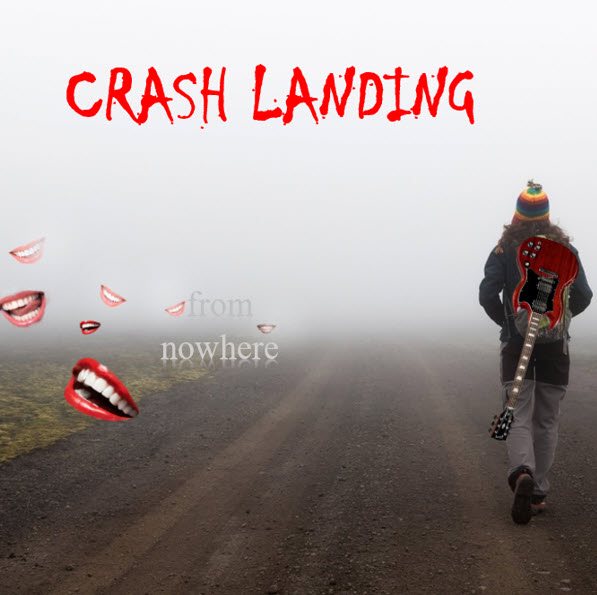 Although the band recorded more than fifty songs (both covers and originals), it was not until 2023 that an album, Smiles from Nowhere, was put together. Comprising eighteen tracks, all were recorded by Peter Stanley at his Muscle Studio in Armidale between June and September 1982. For these, Rod Clay and Doiran James are joined by Jon Anderson, Ashley Carroll, Pat O’Brien, Lindsay Johnson, and Dick Rummery. Jon Anderson provides lead vocals for two of the songs. The band’s amicable demise came about in early-1983 when Ashley Carroll returned home, and the others expressed a desire to pursue new musical directions. Doiran James went on to form The Zip, while Anderson and Clay’s next project became Shoot the DJ.
Crash Landing. “Keeping Beat” (1982). [words/music: Rod Clay]
Crash Landing. “You Saved the Day” (1982). [words/music: Doiran James]
Crash Landing. “Paradise” (1982).
Crash Landing. “Mayday” (1982). [words/music: Rod Clay, Doiran James, and Peter Stanley]
For more Crash Landing songs and production/musician credits see Smiles from Nowhere (2023) at “Music Hub: HGWT Releases” page.
- Discography [pdf] incl. additional photos and images
- Repertoire [pdf]

 Have Gravity Will Threaten