
Northern Tablelands – C: Pre-Pub Rock Era [The 1960s]
The following biographies provide details on individuals and bands which pre-date the Australian pub rock era, which is generally considered to have emerged in the early 1970s. The Northern Tablelands Music Industry Archive recognises, however, the important role that the musicians from the region played during the 1960s in helping to establish the basis of a local industry.
Contents
- Aubrey, Neil
- Firebirds
- Generation, The
- In Sect
- Jaggers, Tony
- McClelland, Mike
- Titanics, The
- Union Jack
~~~
NEIL AUBREY
(1952-)
- Bands incl. The Firebirds ▪ The Generation
Guitar/keyboards

with The Generation (1968)
Neil Aubrey, nicknamed “Nobby” during his youth, grew up in a creative family, with both his parents being actively associated with the Armidale and District Musical Society – his father, Keith, as musical director conductor, and his mother, Olive, as stage director. Aubrey learned to play classical piano from an early age, and while attending The Armidale School (TAS) in the mid-1960s he occasionally played with local band Firebirds, contributing with his Farfisa electronic organ. During this same period he became friends with guitarist Laurie Wheaton (later with Bogislav). This association eventually saw him take up guitar, and according to Tony Jaggers, “Nobby” began mastering the new instrument almost immediately. After transferring to Armidale High School in 1967 Aubrey met Jaggers (previously with The Union Jack and In Sect) and together with former In Sect drummer John Patterson, co-founded The Generation. The band went on to play numerous local gigs, notably the Police Boys Blue Light dances and college and university balls. Jaggers records, too, that they played as far away as Tamworth and Gunnedah, even though still high school students. The Generation also competed in two Hoadley Battle of the Sounds competitions (1968 and 1969).

2008
No details of Aubrey’s association with rock bands and music performance from 1970 onward have yet been uncovered. However, it is likely that he continued to be involved in some capacity while undertaking training as a teacher at the Armidale College of Advanced Education (formerly Armidale Teachers’ College). Neil Osborne records that Aubrey (described as a “wild one”) and his wife were living in Inverell in 1977. The following year they settled on the Central Coast of New South Wales Coast, with Aubrey becoming a music teacher at Gorokan High School. He has continued his association with the school for more than three decades (in recent years this has also included teaching computer studies).
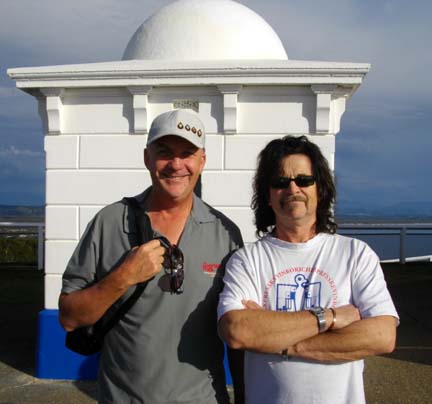
Neil Aubrey (L) and Tony Jaggers (R),
Aubrey’s involvement with musical performance has also seen him actively involved with the Central Coast Music Society, under whose auspices he has published several music text books – notably the Gorokan Workshops series. In addition to his teaching Aubrey has continued to perform solo classical concerts. Among the highlights of his career were concerts in Banff, Canada.
- Visit Neil Aubrey at YouTube for selection of Aubrey’s performances. These include “Sayonara” and “Ms Diana” (Don Alder), Akaskero (Thomas Leeb), “Catherine” (Don Ross), “The Handing Down” (Edward Gerhard), and his own composition “Flow.” The channel also includes favourite performances by other people. [sighted 7/09/2023]
Source: Tony Jaggers (correspondence, Nov. 2010). Images: The Generation and Aubrey/Jaggers photos courtesy of Tony Jaggers † • 2008 photo courtesy of Neil Aubrey and YouTube.
FIREBIRDS
(ca. 1963-1964)
- Personnel: Keith Cornish (guitar/vocals) ▪ Ian Cornish (guitar) ▪ Greg Goldsmith (bass) ▪ Ralph Monley (guitar) ▪ David Tapp (lead guitar/harmonica) ▪ Geoff Walsh (drums).
- Also associated with the band: Neil “Nobby” Aubrey (keyboards)
Firebirds formed at Armidale High School in 1963. The band initially comprised the two Cornish brothers, Ralph Monley, Greg Goldsmith and Geoff Walsh. Goldsmith had the then dubious ‘honour’ of being the son of the school’s Deputy Principal. When the Cornish brothers left Armidale with their family for Casino at the end of 1963, their replacement was, as Tony Jaggers’ recalls, ‘a stunning musician called David Tapp on lead guitar and harmonica.’ The new line-up was also sometimes joined by The Armidale School (TAS) student, Neil ‘Nobby’ Aubrey on Farfisa keyboards. Jagger also recalls that the band’s equipment included Fi-Sonic and Super Twin amps. Ralph Monley was also noticeable for his flame red Maton guitar.
Sources: Tony Jaggers (correspondence, Nov. 2010).
THE GENERATION
(1967-ca. 1970)
 L-R: Neil Aubrey, John Patterson, Tony Jaggers, Laurie Wheaton

- Personnel: Neil ‘Knobby’ Aubrey (lead guitar) ▪ Tony Jaggers (bass/lead vocals/keyboards) ▪ John Patterson (drums) ▪ Laurie Wheaton (rhythm guitar/bass)
The Generation’s origins date back to 1966 when Neil ‘Nobby’ Aubrey, Laurie Wheaton and a fellow student began jamming together while students at The Armidale School (TAS). Aubrey had previously been loosely associated with the band Firebirds, occasionally playing keyboards with them. In 1967 Aubrey left TAS to attend Armidale High School, and while there he met Tony Jaggers (The Union Jack and In Sect). They eventually decided enter the following year’s Hoadley Battle of the Sounds competition, but this forced a line-up change when the other TAS musician was denied permission to become involved. Although Jaggers was a guitarist he took on the bass role, while former In Sect drummer John Patterson was brought in to complete the rhythm section.
The 1968 Armidale heats of the Battle of the Sounds was one of Generation’s first gigs. In correspondence Tony Jaggers recalls that no one could hear the lead guitar on the opening song (an instrumental), because ‘Nobby’ Aubrey had not had time to work out the switches on the Fender Jaguar guitar loaned to him for the occasion by Finx guitarist Snowy Townsend. “No-one seemed to notice, though” he adds, including the band, as it was well before the invention of fold-back systems. The problem was fixed for the second song, Free’s “Gimmie Some Lovin’, but although Generation was accorded an enthusiastic audience reaction, Finx went on to win.
Within a short period of time the band began finding work both in the immediate Armidale/Uralla district and beyond. Jaggers further recalls that the band travelled to Guyra and Tamworth, and even as far as Gunnedah. Local gigs included the University of New England (UNE) and Teachers’ College balls, as well as regular Police Boys Club Blue Light dances. Generation was also the support act for many touring bands, including Johnny Farnham, Normie Rowe, The Flying Circus, The Valentines, The Executives, Cleves, Jon Blanchfield, The Groove and The La Di Das. The latter support was played in the Armidale basketball stadium, and according to Jaggers, the La Di Das stage and equipment took up about half the venue.
The band’s repertoire was initially an eclectic mix of Australian and international songs, notably Shadows instrumental (“The Rise and Fall of Flingal Blunt”), a La Di Das-inspired version of Traffic’s “Heaven is in Your Mind,” and a cover of Cleves’ version of the Tim Hardin classic “If I was a Carpenter.” Another remembered song is Eddie Cochran’s “Summertime Blues,” which they played in similar style to Blue Cheer.
By the end of 1968 Laurie Wheaton had moved to bass allowing Tony Jaggers to concentrate on the frontman/lead singer role. He also occasionally played a Farfisa keyboard. The following year the band again entered the Battle of Sounds, but this time took the opportunity more carefully. Jaggers’ admits that they even spied on Finx during one of its rehearsals. The Generation’s opening song for the Armidale heats (“Summertime Blues”), was a non-judged warm-up and began with the house lights down. A strobe light (possibly never used before in Armidale at that time) started up as the band took the stage and began playing. While the two competition songs were performed above expectations they paled somewhat to the spectacular intro and the band failed to place. Undeterred they played the same set in reverse at the Tamworth heats a couple of weeks later but this time were beaten by Doug Parkinson and his band.
By the end of the year some internal disruptions started to develop. Tony Jaggers admits that he was partly to blame in this respect. As the others were attempting to advance their musical abilities, he was more interested in the showmanship. “I was side-tracked by the fun part,’ he writes. He also recalls becoming increasingly interested in certain illegal substances. In December the other members politely informed him that they intended to pursue other musical directions, and he left the region soon after to go surfing. It is unclear how long the band continued into the 1970s, but it may not have been long, as Laurie Wheaton became one of the founding members of Armidale band Bogislav in 1970 or 1971.
Source: Tony Jaggers (correspondence, Nov. 2010). Image: Courtesy of Tony Jaggers.
IN SECT
(1965)
- Personnel: Tony Jaggers (guitar) ▪ Craig Vaughan (bass) ▪ Noel McCrae (vocals) ▪ John Patterson (drums)
Formed in 1965, In Sect comprised Tony Jaggers, Craig Vaughan and Noel McCrae (vocals). The band never had a permanent drummer, being forced to rely on the availability of several locals. In correspondence Tony Jaggers records that his first choice was always John Patterson, the son a well-known local drummer. “Patterson,” he notes “was one of the finest I’ve ever played with [and thankfully mostly] on call. He also played at times with Finx and Firebirds.”
In Sect often hired halls to play its own gigs, with one of the best being the basement under the Armidale Town Hall. A friend, Tony Singh, would look after the door and there was never any need for security. As Jaggers further recalls, the local girls were “caught up in the revolution and a good time was had by all.'” The band’s amplification comprised a Fi-Sonic amp, Jaggers’ Goldentone amp (with 6×6 inch speakers) and a bass bin built by Craig Vaughan which he built in the woodwork room at school. He also built the amplifier, with the speakers reversed and channeled out. As Jaggers’ records, it was a “bit like sub-technology.”

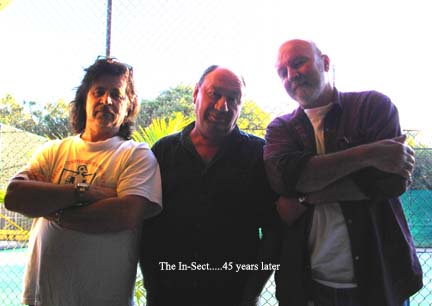
In Sect reunion (2009)
Source: Tony Jaggers (correspondence, Nov. 2010). Image: Courtesy of Tony Jaggers.
TONY JAGGERS
(1950 -)
- Bands: Generation ▪ In Sect ▪ Union Jack
Tony Jaggers, who left the Northern Tablelands in late-1969, exemplifies the career of a journeyman musician whose earliest musical opportunities were experienced as a Uralla/ Armidale teenager during the 1960s. After co-founding the bands In Sect (1965), The Union Jack (1966) and The Generation (1967), Jaggers initially pursued a surfing lifestyle. He re-gathered his music mojo after attending Australia’s first music festival Ourimbah, and since then has played in many different bands, while occasionally taking time out to surf, try the hippy lifestyle and at one stage to manage a radio station.
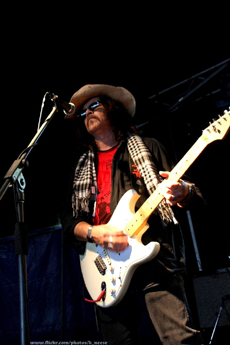
Tony Jaggers – Barooma 2009
In 2002 Jaggers decided to abandon the security of playing in a band and put together a solo acoustic act, and has since performed at the Thredbo Blues Festival, four Great Southern Blues Festivals, Tumba Fest and a couple of “guest” spots at Broadbeach Blues (Qld). Jaggers’ act has evolved in response to his developing sequencing and home studio recording skills and now sees him use utilise backing tracks to create a rock sound that allows him to venture into the pub and club market. He has subsequently played gigs from from the Victoria border to Wollongong, Canberra to the Southern Highlands and all points in between.
In the early-2000s Jaggers discovered the art of woodturning, and for the next decade and a half devoted much of his time to turning out burl timber bowls, including a series of extra large natural edge bowls commissioned by a gallery in Texas (USA). He returned to playing music in 2017 after a traffic accident made woodturning too difficult for his hands. Then, when the covid epidemic closed down his music opportunities in 2020he returned to making bowls again, but via a lathe.
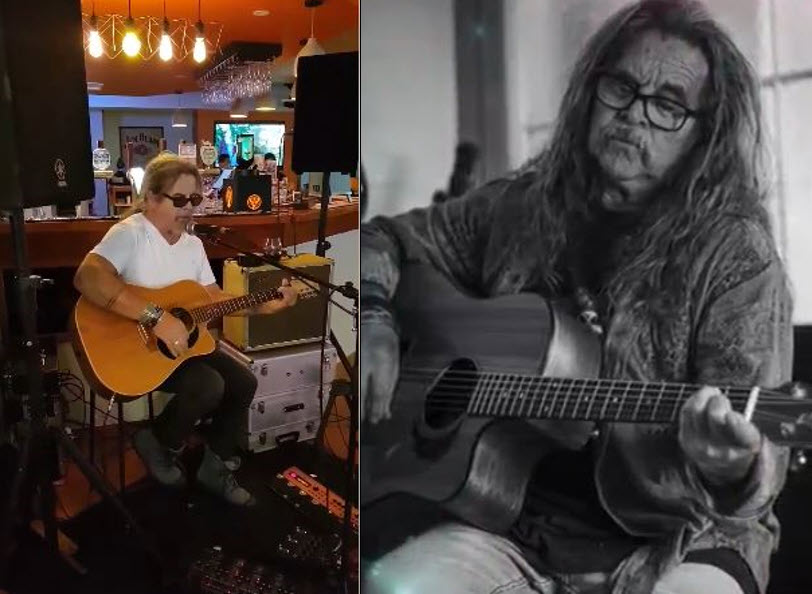
 L: Sins Bar & Grill (Bateman’s Bay, NSW) 2017 ▪ R: Tukka Licenced Cafe (Moruya, NSW) 2022
- To find out more about Tony Jaggers visit: Tony Jaggers (website). See also his YouTube channel (tonecontrol56) [sighted 8/09/2023]
- [It’s Too Late] Live at the Great Southern Blues Festival, Narooma (3 Oct. 2014) YouTube clip
- “Slow Boat to Memphis.” Live at the Great Southern Blues Festival, Narooma (2 Oct. 2015) YouTube clip.
Source: Tony Jaggers (correspondence, Nov. 2010). Images: Courtesy of Tony Jaggers.
MIKE McCLELLAN
(1945 – )
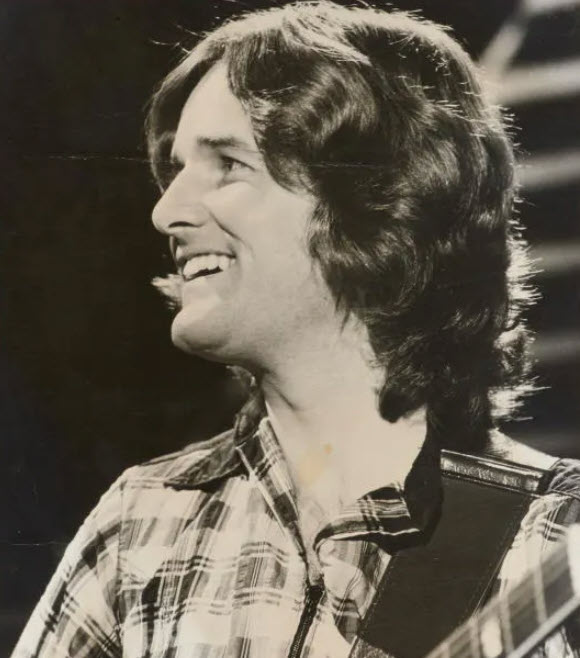 Melbourne-born, Mike McClellan’s association with Armidale and the New England/Northern Tablelands region of New South Wales began in 1963 when he undertook a year of training at the Armidale Teachers’ College. While there he learned guitar while singing pop tunes with the college band. He is believed to have performed at a number of shows in Armidale, including the C.B. Newling Auditorium at the Teacher’s College. In a Rolling Stone magazine interview McClellan said of his time in Armidale, “it was my first opportunity to get involved with music away from home” (ctd. McArthur p. 14).
During occasional trips to Sydney McClellan became aware of the developing folk scene there, and this in turn influenced the direction of his music. It was also a period when folk music was becoming more widely recognised through Woody Guthrie and emerging artists like Bob Dylan, Jonie Mitchell, Peter Paul and Mary and James Taylor etc. After graduating he returned to Sydney to take up a career as a teacher but at the same time immersed himself in the local folk scene – both as a solo artist and as a member of the Currency Blues Band. Among his peers were the likes of Gary Shearston (who had an international hit in 1974 with his of Cole Porter’s “I Get a Kick Out of You“), Margaret Roadknight, Jim Carter and Doug Ashdown.
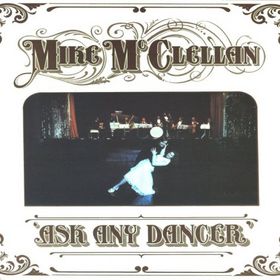 McClellan’s teaching career effectively ended after he won a heat of the TV quest New Faces and subsequently took up an offer of regular work on the variety program Sound of Music. He released his first LP Mike McClellan on Col Joye’s ATA label in 1972. It includes the song “There is a Place (New England’s Hills).” That same year he played the first of many annual visits to Armidale and other Northern Tablelands centres. Terry McArthur records that McClellan’s saw these gigs as a way to renew his roots and as a means of returning something to the town that provided him with much of his initial impetus (p.14). By 1974, when he released his second album – the top-selling Ask Any Dancer – McClellan was already one of the country’s leading folk entertainers. One of the songs from the album, “Rock’n Roll Lady,” was voted ‘Song of the Year’ at the 1975 Australian Music Industry Awards. His popularity in Armidale by that stage meant that he was required in 1975 to play a second concert – the first having been booked out weeks in advance.
McClellan’s albums from the 1970s were Until the Song is Done (1976) and An Evening with Mike McClellan (1978, live). In 1979 he compered National Star Quest on television, and this led to him taking over the host role for the ABC’s Country Road program. It continued as Mike McClellan’s Country Music for three years.
Mike McClellan’s songs have been covered by a number of artists in Australia and overseas, including John Farnham and Rick Nelson. Over the years he has toured with such international acts as Roger Miller, Melanie, Dr Hook, The Hollies and Leo Kottke. His album releases to date also include Laughing in the Dark (1908), The Heartland (1990) and Time and Time Again (2001) a 2CD retrospective.
Mike McCellan. “Song and Dance Man.” (1974) [words/music by Mike McClellan] From the album Ask Any Dancer (EMI).
- See the Mike McClellan website for further career details.
- See also Malcolm J. Turnball’s article “Key Players on the Sydney Coffee Lounge Scene” republished in Warren Fahey: Exploring Australian Identity Through History, Story, Song and Folklore (website).
- “Mike McClellan: Where Does He Go From Here?” (1976) Neucleus review [PDF] republished in NTMIA
Sources: Terry McArthur “Mike McClellan: Where Does He Go From Here?” Neucleus 7 Apr. (1976), p. 14 • Mike McClellan (website) • Malcom J. Turnball “Key Players on the Sydney Coffee Lounge Scene.” (online) ▪ Image: EMI publicity photo, ca. 1970s (source Powerhouse Museum).
THE TITANICS:
( ca. late-1960s)
- Personnel: George Boyer (organ) ▪ Dennis Hunt(drums) ▪ Robert Matley (lead guitar) ▪ Ron Matley (vocals) ▪ Leon Smart (bass guitar)
Possibly Glen Innes’ first rock band, and certainly one of its most popular during the early pub rock era, The Titanics formed in the late-1960s and quickly established itself in the nearby districts. The band is believed to have travelled further a field during its time together, including gigs as far away as Armidale and Inverell.
Source: Bill Hughes “The Music of Glen Innes,’ Land of the Beardies History House Museum Vol 28 (2001-02), p.9 (thanks to Eve Chappell).
THE UNION JACK
(1966)
- Personnel: Neil Hunt (drums) ▪ Denny Goodhew (guitar) ▪ Tony Jaggers (guitar) ▪ Robbie Paulson (bass)
The Union Jack established itself in the Armidale/Uralla district in 1966. According to Tony Jaggers the band members were all fairly inexperienced and essentially learned the business as they went along. “Robbie had never played [before] but turned into a pretty good bass player,” he notes. “We did the usual thing, hired church halls, school socials and for two weeks were the resident band four nights a week at an ill-conceived [social] in the unused Uralla Theatre. We were never paid… welcome to the music biz!!” The band folded when Jaggers gained his drivers’ license and began hanging out in Armidale more often, which eventually led to him co-founding The Generation.
 Have Gravity Will Threaten