
Artists/Bands [S]
Scamp to Shearwater ……. 1.
Shooting School to Shoot the DJ
Jo-Ann Simmons to John Solomons ……. p.3.
Some Trippin’ Diggers to Preston Stahlut ……. p.4.
Pete Stanley to Sundown ……. p.5.
SHOOTING SCHOOL
(ca. 1984-1985)
-
Personnel incl. Chris Green (guitar/vocals) ▪ Richard Rummery (keyboards/vocals) ▪ Ross Stagg (lead vocals/guitar) [below] ▪ Jeff Stone (bass) ▪ Kim Williams (drums)
Ross Stagg is an Australian-born musician who had found some measure of fame in Britain and Japan in the mid to late-1970s as the lead singer and lead guitarist of the hard rock band Strapps. Prior to this he had released a solo single in the UK on the Dawn label titled “I’ll Never Be a Star (But I Might).” With Strapps he released four studio albums, a handful of singles, and toured with some limited success in Britain and with much more success in Japan. Strapps also played high profile support gigs with Deep Purple and the Ian Gillan Band. When drummer Mick Underwood left to join Ian Gillan’s new outfit, Strapps folded, and Stagg eventually returned home. By 1984 he had scored a publishing contract with Castle Music Australia, signed a recording deal with the Mercury label (a subsidiary of Polygram Records), and put together an all-together different sounding band, with a more polished and distinctive ’80s sound.
Although based out of Sydney, and therefore not an Armidale-based band, Shooting School nevertheless had a number of strong connections with the regional city. Both Chris Green and Richard Rummery were former Armidalians, and had begun their musical careers there. Lynn Stagg, the wife of band leader, Ross Stagg and a close friend of poet Jo-ann Simmons, had also lived in Armidale for a number of years. Both Lynn and Ross later collaborated with Simmons and Clay Djubal with the Some Trippin’ Diggers collective.
Shooting School formed sometime around 1984. Ross Stagg was at the time signed to music publisher Castle Music. He enlisted the aid of Rummery, Green to help form the band, which was subsequently signed to Polygram/Truetone on the Vertigo label. Essentially a mainstream pop/rock band with some prog rock influences, Shooting School’s debut, and only release was the single “You Won’t Listen” b/w “Bring Me Water.” Its production was overseen by American producer Alan Mansfield at INXS’s Rhinoceros Studios. Mansfield had previously worked with Robert Palmer, Dragon and Boz Scaggs. The film clip that accompanied the single was directed by Kimbel Rendall (who’d previously worked with Men at Work). The band then toured extensively, including a three month national tour as support to Dragon. Other key songs written by Ross Stagg during this period include “Flame,” “Capital,” “No Reason” and “Dream of a Nation.” Stagg later reworked these songs for a solo project tentatively titled The Stagg Corporation. Shooting School’s version of “Capital” is included as a final track. The newer version appears earlier in the demo.
Shooting School’s rise to the top of the Australian industry appeared to be almost certain. The band’s single had begun to get national rotation airplay, a video had been made, they had willing support from their label, and then disaster struck when the major commercial radio networks placed a ban on all records released through Polygram. With all its impetus dead in the water, musical and personal differences came to the fore and soon afterwards the band imploded. Each of the members subsequently went off to explore different musical directions.

Ross Stagg †
Ross Stagg: In the early-1990s Ross Stagg began what has been a two-decade long association with TAFE New South Wales. He has been a teacher, curriculum writer, mentor and and Senior Education Officer at the Nirimba Contemporary Music Centre, the Hunter Institute, and TAFE Entertainment (Sydney). In addition to these positions he has served as a Rock Panel member for the New South Wales Ministry for the Arts advising the New South Wales Government on policy for contemporary music within the broader arts context, and was instrumental in the formation of MusicNSW.
Ross Stagg’s career in the music industry has included positions as an Artist and Repertoire executive and House Producer for Sony (CBS) in the UK. He released four albums with Strapps for EMI, toured internationally and is a published songwriter with Rondor Music Publishing (UK). His involvement with theatre has seen him write several musicals and oversee a number of productions as director, including plays for Short and Sweet: Central Coast in 2007 and 2009.
Shooting School. “You Won’t Listen.” (1984) Single (A-side)
Shooting School. “Bring Me Water.” (1984) Single (B-side)
Shooting School. “Capital.” (1985) From Ross Stagg’s unreleased album The Stagg Corporation.
-
This Shooting School version is included as the final track.
Strapps. “Child of the City.” (1977). Single from Secret Damage.
Strapps. “Bring on the Thunder.” (1979) From Ball of Fire (Ross Stagg & Strapps).
- All songs written by Ross Stagg
NB: Strapps’ MySpace page records: “This UK hard rock quartet was formed in 1975 by Ross Stagg (vocals, guitar), Noel Scott (keyboards), Joe Read (bass) and Mick Underwood (drums; ex-Quartermass), and were picked up by EMI Records the following year. Drawing their inspiration from Deep Purple, Thin Lizzy and Uriah Heep, they released four albums over a five-year period. These met with very limited success, except in Japan, where they maintained a cult following. Strapps never graduated from support act status in Europe, which was a fair summation of their true potential. The band disintegrated in 1979, when Underwood joined Gillan” [sighted 1/09/23]. The site has since been abandoned and the music lost in 2018 during MySpace’s botched server migration. A live album, recorded at the Rainbow Theatre in London in 1977 was released in 2008.
- Discography [pdf] Shooting School only
Sources: Australian Songwriters Conference 2010 (online) • Clay Djubal (2009) • Richard Rummery (correspondence, 2009) • Short + Sweet Theatre (online) • “Strapps.” Wikipedia (sighted 25/09/2023).
SHOOT THE DJ
(1982-1986)
 L-R: Ian Mitchell, Clay Djubal, Ziggy Mirza, Jon Anderson

- Personnel: 1982-1984 (I): Jon Anderson (guitar/vocals/sound) ▪ Clay Djubal (bass/vocals/songwriter) ▪ Siegfried ‘Ziggy’ Mirza (lead guitar/vocals) ▪ Ian Mitchell (drums/sound)
- Associate members: Jo-ann Simmons (live sound/lighting/lyrics/”sound advice”) [below] ▪ Dirty Dan (aka Darrell Mitchell; drums – one gig) ▪ Doiran James (guitar/vocals) and Richard Rummery (drums) early period only.
- Personnel: 1985-1986 (II): Clay Djubal (bass/keyboards vocals/songwriter) ▪ Nick Miles (guitar/harmonica/vocals/songwriter) ▪ Ian Mitchell (drums/sound/songwriter).
- Associate members: Jo-ann Simmons (lyrics/lighting/”sound advice”) [below] ▪ Siegfried “Ziggy” Mirza (bass/vocals – on tour, 1986 and guitar/vocals on early recordings) ▪ Doiran James (guitar/vocals) early recordings only.
Emerging out of the Armidale “hippy punk” movement of the late-1970s, Shoot the DJ was a theatrical rock band based in the New England region of New South Wales (ca. 1982-84) and later in Sydney (1985-1986). The band’s musical influences ranged across a diverse number of genres, including classic rock, hard rock, punk, art rock, bubblegum pop and film themes. While Shoot the DJ did not release any recordings at the time, its music was played on ABC radio’s Triple J network. During its Armidale tenure the band regularly toured the North-West and North Coast regions, including centres such as Tamworth, Uralla, Inverell, Narrabri, Dorrigo, Coffs Harbour, Byron Bay, Grafton and Macksville.
Shoot the DJ formed after the demise of Crash Landing. The initial un-named line-up comprised Jon Anderson, Clay Djubal and Doiran James (all from Crash Landing) and Richard Rummmery (ex-Vice Squad). James and Rummery soon afterwards left to pursue other projects and were replaced by Ziggy Mirza and Year 12 Duval High School drummer, Ian Mitchell. After settling on the name Shoot the DJ (a non-too subtle dig at the disco scene), the band began playing local parties and community events before securing its first paid gig at the Imperial Hotel. By the end of the year Shoot the DJ had played support to several touring acts (Matt Taylor, Kevin Borich Express, Mi-Sex, The Beatnix and the Lonely Hearts), while also securing work around the region, either through self-management or with John Logan Entertainment and Horizon Entertainment. The band was also associated with such local acts as Dinosaurs from China, and The Zip, as well as Mixt Company, a group from Macksville, on the New South wales mid-north coast (and featuring Jon Anderson’s sister, Jen Anderson). Although Shoot the DJ’s line-up remained stable throughout 1983-84, it was forced to bring in Darrell Mitchell (aka Dirty Dan) to replace Ian Mitchell for one gig (Uralla).† Mitchell was at the time attempting to complete his final exams.
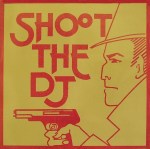
Shoot the DJ’s distinctive stage shows (with designs by Clay Djubal and Jo-ann Simmons) set them apart from all other regional New South Wales bands. One series of shows, for example, saw them set up the stage as a one room apartment – complete with furniture (a bed, stocked fridge, coffee table, sofa, paintings, plants etc). Halfway through the first set one of the band’s friends popped out of the cupboard and made himself at home on the stage. As the evening progressed more and more invitees joined him on stage until a full on party eventuated (the bed became a particular favourite with both friends and band). For its 1983 election day gig (won by Bob Hawke’s Labor Party) the band set up a TV on stage so that people could watch the results. The admission price was dropped by a dollar that night if patrons said that Hawke was a good bloke (apparently some people still preferred to pay the extra buck!). Another set required the entire stage (including amplifiers, PA speakers, drum riser and side screens) wrapped in alfoil, creating an massive light show with minimal lighting. The band’s live appearances would also involve poetry readings, theatrical scenes played out by actors, live television broadcasts and a multitude of theme-related props, ranging from skeletons and blow-up sex dolls to original artwork and paintings by Clay Djubal.
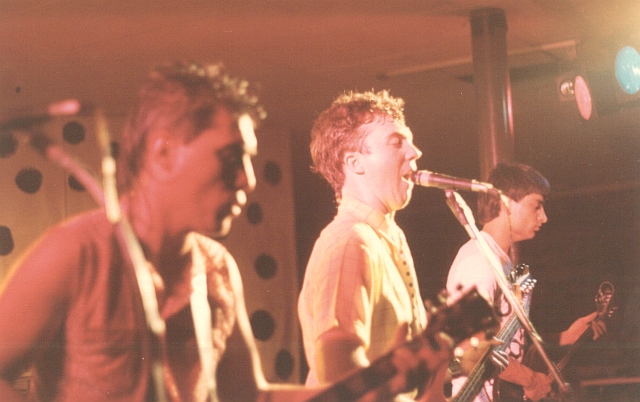
Shoot the DJ frontline
The band’s driving rhythm section, largely reliant on sonic compression, was punctuated by Anderson’s quick-fire punk-driven rhythm guitar and overlaid with Mirza’s sizzling lead guitar work. Three distinctly different voice timbres provided a rich mixture of lead and harmony vocals.

Ian Mitchell
The themes explored in their largely original repertoire relied less on traditional rock/pop relationship-subjects than they did on life in Australia at that time, and particularly regional Australia (“Wilcannia,” “On the Nullarbor” and “Australian Holiday“). Among other subjects explored were: recreational drugs and the heroin-related deaths of friends (“Cop Out,” “Radio 2LSD,” and “Frizzy Lizzy’s Fun Factory“); satirising cigarette advertisements (“When Only the Best Will Do“); the frustration of having little money and no obvious future (“Street People” and Paralytic with Intelligence“); life as a musician in a country town (“Keeping Beat” and “Put the Boy Down“); and the questioning of religious faith (“How Does it Feel, Mary?“). A number of songs were co-written with poet Jo-ann Simmons who had been with the band from its inception, first as sound/lighting operator, and later as lighting operator. She and Clay Djubal were married between 1984 and 1989.
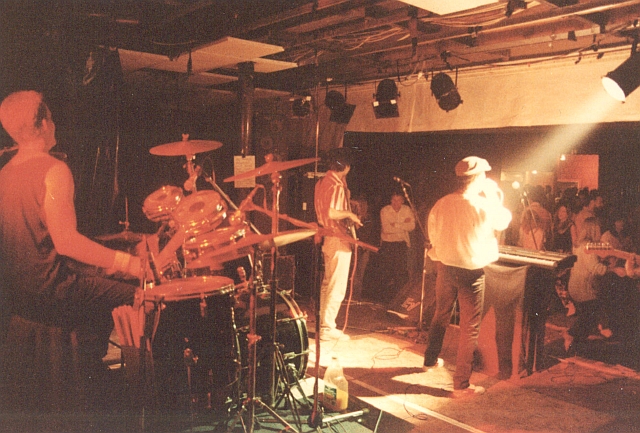
Shoot the DJ (II) – 1985 NSW North Coast tour
Shoot the DJ temporarily disbanded in 1984, when Djubal, Mirza and Mitchell relocated to Sydney (Jon Anderson remained in Armidale due to his work commitments with Telecom). Ian Mitchell’s move was in order to join his brother Peter Mitchell in Captains of Industry, while Clay Djubal and Ziggy Mirza became involved with a loose collective of musicians and creative artists which came to be known as Some Trippin’ Diggers. Within a year, however, Shoot the DJ was reformed as a stream-lined three piece band (Djubal, Mitchell and former Grafton guitarist, Nick Miles). Ziggy Mirza, who had by then joined the Sydney band, Native Tongue, helped record a bunch of new songs before Miles was engaged, and returned in early-1986 as bass guitarist for a northern New South Wales tour (with Helga ünd der Blitzkrieg). The band played as a three piece in their set and with Mirza in the second – thereby allowing Clay Djubal to focus on lead vocals and keyboards. The group disbanded not long after the tour when it became apparent that each of the members were keen to move in different career directions. Although the Mark II version of Shoot the DJ recorded an album’s worth of material during this period nothing was ever released until 2008.
Shoot the DJ (Mk I). “Put the Boy Down” (live, 1983) From Crunch Time: Live at Impies.
Shoot the DJ (Mk I). “Cop Out” (live, 1983) From Crunch Time: Live at Impies.
Shoot the DJ (Mk II). “Time Flies” (1985) From Mind-Driving, 2008.
Shoot the DJ(Mk II). “You Said (I Hate Men).” (1985) From Mind-Driving, 2008.
Shoot the DJ (Mk II). “Put the Boy Down.” (1985) From Cleared for Action, 2008)
-
“Put the Boy Down” written by Doiran James and Clay Djubal ▪ “Cop Out,” “Time Flies” (ft. Ziggy Mirza, guitar), and “You Said (I Hate Men)” (ft. Nick Miles, guitar) written by Clay Djubal.
-
You can access more music from Shoot the DJ in the AVTA’s Music Hub 1 section.
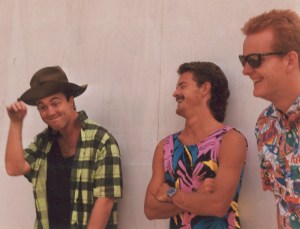 Shoot the DJ (II). L-R: Clay, Nick and Ian
- Discography [pdf]
- Gigography [pdf]
- Song List [pdf]
 Have Gravity Will Threaten